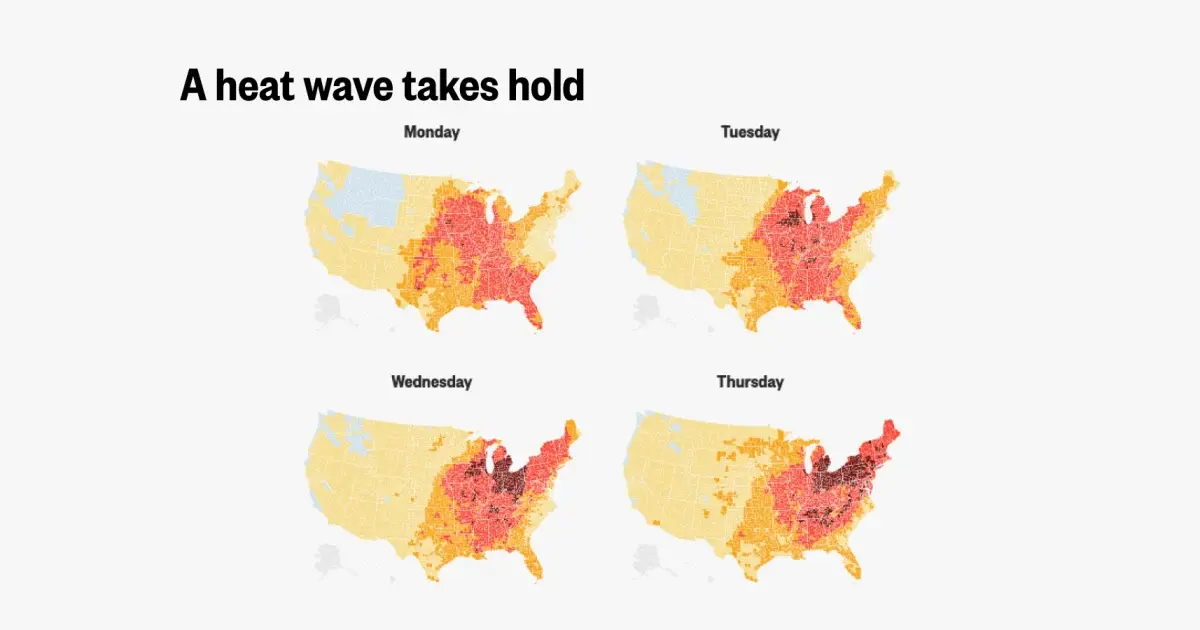
This is not a normal American summer. A heat dome parked over the eastern two-thirds of the United States for the July 4th weekend 2026, exposing more than 230 million people to temperatures above 90 F and pushing heat indices past 115 F in parts of the Mid-Atlantic. More than 160 million Americans were under active heat alerts. Extreme heat kills more Americans every year than any other weather event: hurricanes, tornadoes, and floods combined.
Americans under heat alerts
160 million+
Americans above 90 F this weekend
230 million+
Peak heat index recorded
115 F (Mid-Atlantic)
Municipalities breaking temperature records
140+
Years of DC daily records broken
120+
Power customers without electricity at peak
200,000+
What Is a Heat Dome
A heat dome forms when a strong high-pressure system stalls in the upper atmosphere and acts like a lid over a region. Air trapped beneath it compresses as it sinks, warming as it descends. The sun keeps adding heat from above. The lid prevents any of it from escaping. Overnight lows fail to drop below 75 to 80 F in the worst-affected cities, meaning the body gets no overnight recovery. That sustained nighttime heat is what turns a hot spell into a killer. The July 2026 dome built over the eastern two-thirds of the country and stalled for five-plus days, coinciding with the nation's largest outdoor gathering in at least 50 years: America's 250th birthday.
Philadelphia, July 3. 103 F.
Washington, D.C., July 4. 102 F.
Boston, July 3. 100 F.
The Science Behind the Danger
Heat kills via hyperthermia: when the body can no longer shed heat faster than it generates it. Sweat is the primary mechanism. When air temperature and humidity are both very high, sweat evaporates slowly and the cooling effect collapses. A heat index above 103 F (the "feels like" temperature that accounts for humidity) is when the body begins to lose the battle. Above 115 F, even a healthy adult at rest can develop heat stroke within an hour outdoors. People without air conditioning, the elderly, outdoor workers, and anyone without access to a cooling center face life-threatening exposure. The CDC recorded 2,394 heat deaths in the United States in 2024 alone, more than double the 1999 figure, and the July 2026 event arrived as the deadliest weather pattern imaginable.
Stay Alive in Extreme Heat: the Rules
Stay indoors between 10am and 6pm on days above 100 F
If you have no AC, go to a public cooling center, library, or mall
Drink water continuously, at least one glass every 20 to 30 minutes
Never leave a person or animal in a parked car, even with windows cracked
Check on elderly neighbours and those who live alone, every day
Avoid alcohol and caffeine, which accelerate dehydration
Know the difference: heat exhaustion (dizzy, sweating, nauseous) vs. heat stroke (no sweating, confused, skin hot and dry = call 911 NOW)
Run cold water over wrists, neck, and ankles to cool core temperature fast
US heat deaths in 2024 (CDC)
2,394
Increase in heat deaths since 1999
nearly 2x
Economic cost of extreme heat in 2024
162 billion USD
Length of average US heat wave season since 1960s
+46 days
Times climate change made this event more likely
800x (March 2026 study)
Heat disproportionately kills. In New York City heat mortality data, 45 percent of people who died from heat exposure in recent years died in their own homes. Of those exposed at home, none had or were using air conditioning. Black and low-income New Yorkers are statistically less likely to have AC due to cost. Cooling centers exist precisely for this gap.